|
What Made Sibley's Great
by
It was a banner year for the Sibley, Lindsay & Curr Company. It was 1926.
Also that year trolley fare was eight cents, Strong Memorial Hospital
opened, Rochester received its first air mail and it was the year that
Rochester's premier department store boasted that "in proportion to the
size of the city in which it is located (325,000), it is unquestionably
the largest store in the country." What made it so large was completion
of a six-story addition to its Mercantile Building expanding that wing
of Sibley's to twelve stories. Later that addition would be known as the
Sibley Tower Building.
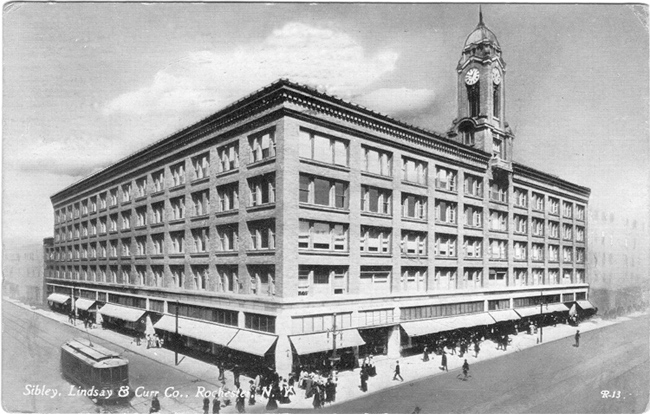
Sibley's was justly proud of its enlarged store that now stood taller
and was larger than any dry goods store between Macy's in New York City
and Marshall Field's in Chicago. Its street frontage was 992 feet almost
a fifth of a mile. It consisted of 271 feet on Clinton Avenue, 195 feet
on North Street and 210 feet on Franklin Street. Within the store the
interior also under-went a renovation with improved lighting, a modern
elevator system, a new terrazzo main floor and the latest store fixtures
and display cases, many of walnut and mahogany.
For those citizens who enjoyed downtown window shopping the expansion
was a delight. The store's huge, twelve-foot plate glass windows were
filled with a kaleidoscope of ever-changing merchandise displays. A walk
around the store's outer circumference, observing the newest fashions
and discovering the latest miscellaneous merchandise was always entertaining
and often educational. A legion of local window dressers must have worked
overtime at their tasks. Sibley's ground floor windows equaled, and perhaps
outnumbered similar windows located in any other dry goods store in the
nation.
A particularly interesting feature of the great store was its "tube room."
Located in the basement, a cadre, comprised of dozens of women, sat at
banks of pneumatic tubes tied to every department throughout the store.
In all, Sibley's had thirty-four miles of such tubing, the largest pneumatic
tube system in the world. The two-inch-wide metal tubes carried felt-ended,
five inch brass canisters to the tube room. Store clerks placed the canisters
in the mouth of a tube, closed a flap, and the customer's purchase transaction
was neatly whisked from the clerk to the basement for processing. Then,
with a pleasing whoosh, the change and receipt was shot back to the clerk.
It was a process that never failed to fascinate all young children and
more than a few adults as well.
There were other assets that made Sibley's unique. Perhaps the most notable
was its two splendid clocks. One was seen in the distinctive tower located
over the main entrance to the huge emporium. For years the clock tower
was used as a logo by the firm on its delivery trucks, shopping bags,
boxes and stationery. The tower's bell that struck the hours weighs a
hefty thirty-five hundred pounds, one of the largest in the city.
The other clock, a huge copper-clad, four-faced affair hung in the store's
main corridor on the first floor by the escalators. To a small child the
clock's six-foot-square size appeared to be enormous. The grand time piece
was a central meeting point for shoppers and a place where Mom told you
to go if you ever got lost from her sight in the store's vast maze of
counters, corridors and crannies. The store even capitalized on the clock's
public popularity. "Meet me under the clock in Sibley's" was a slogan
often heard from the 1940s through the 1960s.
A side-bar to the tale of the great shopping emporium is the legend of
Michael P. Filon, and how his name appears on the front of Sibley's just
above the fifth floor level under the clock tower. Shortly after the disastrous
downtown fire in 1904, the Sibley management purchased its new site at
the corner of North Clinton and East Main Streets. All the real estate
was purchased save for a block of land the Filon family refused to sell.
The parcel fronted on East Main Street and harkened back to the time when
Mr. Filon, President of the Bay Railroad, Mayor of Rochester in 1862-1863
and President of East side Savings Bank, acquired the property. The Filon
section was both strategic and necessary to complete the new construction.
After considerable negotiation, a lease was finally hammered out and
construction begun. However, the "Filon section" of the store was kept
a "separate entity" with its own utilities and stairway and elevator space
allowed for if needed. In the late 1940s, Louise Kelly, granddaughter
of Michael Filon, passed away leaving her estate to R. I. T. It was not
until then that Sibley's purchased that part of its store lot. The Michael
Filon plaque, permanently attached to his "Filon Block," on the "Filon
Tower," can be spotted if one takes a moment to locate it.
Sibleys installed four new Otis elevators in November, 1942. Small kids
were fascinated by the highly polished, fossil-filled marble that flanked
the elevator entrance doors. What took their parents' attention however,
were the three splendid, panoramic plaster panels above the elevator bank.
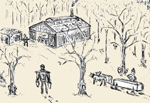
The huge panels each depict a stage in Rochester's vibrant growth. The
first, entitled "Birth of the Genesee Milltown 1789-1825," shows the High
Falls, flour mills, a log cabin and an early settler with his ox team.
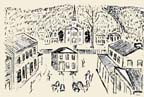
The second, "The Flour City 1840-1860," represents the growth of retail
business, elegant homes and the massive aqueduct on which the Erie Canal
spanned the Genesee River. The final panel, "The Skyline of Our Modern
City," displays its many industrial and towering office buildings and
spacious stores. An eagle, with wings outspread, stands above the buildings,
perched and ready to soar into a bright new future. In 1942 the panels
seemed both appropriate and comforting to citizens living in a nation
at war.
Other great memories of Sibley's include: the big, revolving entrance
doors, the city's first escalators, the cosmetic, appliance and craft
demonstrations by the first floor escalator, the food and kitchen-device
demonstrations on the fourth floor, toy land with its wondrous tunnel
featuring Christmas or story book scenes complete with animated figures
or elves, the huge balloons used in the Santa Claus Parade down Main Street,
dinner with Santa, the Salvation Army bell-ringers at the store's entrances
each Christmas season, the Scholastic Arts Award Exhibition on the fourth
floor, the sprightly seasonal decorations that wreathed the giant first
floor pillars, the third floor fabric and craft department where grey-haired
ladies, with years of expertise, would show you how to knit and crochet,
the fashion-show models in the sixth floor auditorium, the delicatessen
in the grocery department, the book department and the 2-cents a day lending
library, the Sibley Tower Restaurant and the express elevator to the sixth
floor one took to get there, the large fleet of dark green delivery trucks
that even brought groceries to your home, the main level coffee shop on
Franklin Street, the wonderful china and crystal department, shopping
for "bargains" in the basement, the delicious bake goods especially the
almond paste Christmas cookies and chocolate cake from the grocery department
and those super sandwiches they'd prepare for you long before they were
available elsewhere, and those oh, so smooth and delectable frosted malteds.
We'll treasure those special memories forever, because they truly made
Sibley's great.
|