|
The Pioneer Settler
upon the Holland Purchase, and his Progress
by
Orsamus Turner from the History
of the Holland Purchase
Fourth Scene

No. 4 — It is winter. Forty-five years are supposed to have passed
since the artist introduced the pioneer and his wife to us, just commencing
in their wilderness home. The scene has progressed to a consummation!
The pioneer is an independent Farmer of the Holland Purchase. His old
"article" has long ago been exchanged for a deed in fee. He has added
to his primitive possessions; and ten to one that he has secured lands
for his sons in some of the western states, to make pioneers and founders
of settlements of them. He has flocks and herds; large surplus of produce
in his granaries, which he may sell or keep as he chooses. He is the founder,
and worker out, of his own fortunes; one who in his old age should be
honored and venerated, for his are the peaceful triumphs of early bold
enterprise, as we have seen; and long years of patient, persevering industry.
He has more than comfortable farm buildings, orchards, and fruit yards;
the forest has receded in all directions; he is prosperous in the midst
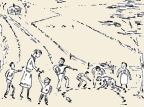
of prosperity. There is the distant view of a rural country village that
has sprung up in his neighborhood; a meeting house, a tavern, a few stores
and mechanic shops, and a substantial school house. The stream that was
forded, when the pioneer entered the forest with his oxen and sled, has
now a stone arched bridge thrown over it. The artist has given us a rural
landscape, in which is mingled all the evidences of substantial, well-earned
prosperity; there is an air of comfort and quiet pervading the whole scene;
the old pioneer, true to the instincts and habits of his youth and middle
age, is not idle, as we can see. He has yet an eye upon his affairs, and
a hand in them; and could we look within doors, we should see the young
wife that bravely penetrated the forest with him; she who has lightened
his burthens, and solaced him in such hours of despondency as will come
upon the stoutest hearts; transformed into the staid, aged matron; yet
looking to the affairs of the household; and blending precept with example,
fitting her daughters for the vicissitudes, the trials, and the duties
of life.
Such has been pioneer life and progress upon the Holland Purchase. A
fancy sketch it may be called; but yet it is a faithful illustration of
such realities as will be recognised by all who are familiar with the
events that have attended the conversion of Western New York, from a wilderness,
to a theatre of wealth, enterprise, and prosperity, such as it is now.
|